
My first month in front of a five minute chart taught me very little about markets and quite a lot about myself. I was impatient, I clicked far too early, and I took every red candle as a personal comment on my intelligence. The chart was never the problem. Nobody had told me which skills I was actually supposed to be building.
That gap is where most beginners get stuck. Day trading gets sold as a knowledge problem, as though the answer were hiding inside one more video about one more indicator. In practice it behaves like a craft, closer to learning to drive in city traffic than to memorising a formula. You improve through repetition under mild pressure, with someone pointing at the right things.
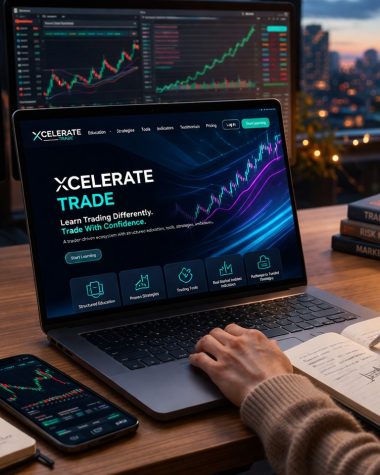
So when people ask what a structured platform can realistically give someone starting from zero, I answer in skills rather than promises. Xcelerate Trade organises its material as a learning path with a practice environment attached, which means the skills arrive in a certain order. What follows is my read on that order and why each piece carries more weight than it first appears to.
Reading a chart without drowning in indicators
The first skill, and the one people undervalue most, is simply seeing what a chart says. Not predicting it. Seeing it. A candle is a compressed record of an argument between buyers and sellers over a fixed slice of time, and once that lands, most of the mystique falls away.
Beginners tend to arrive through the indicator door, because indicators feel like tools and tools feel like competence. Six overlays and three oscillators later, they still have no opinion about the market in front of them. The Academy material inside Xcelerate.Trade pushes the other way, teaching structure in price first and treating indicators as confirmation rather than as the strategy itself.
Candles carry intent, not prophecy
A long wick under the body of a candle means somebody stepped in and bought aggressively into weakness. It does not mean price will now rise. That distinction reads as pedantic until you have paid for it a few times.
Learning to see intent changes the way you talk to yourself while trading. Instead of thinking this looks bullish, you start thinking sellers pushed here twice and failed, so my level is probably real. That is a measurable upgrade in reasoning, and it usually shows up within a few weeks of deliberate practice.
The technique also comes with a good story behind it. Candlestick charting grew out of the Japanese rice markets of Osaka in the eighteenth century, where traders at Dojima were pricing forward contracts long before European exchanges formalised anything comparable. It reached English speaking traders properly in 1991 through the work of Steve Nison, which is why the vocabulary still carries Japanese names.
Timeframes work as a hierarchy
The other half of chart literacy is grasping that timeframes are nested rather than competing. The daily sets the terrain, the hourly sets the tone of the session, and the five or fifteen minute chart is where you actually act. Skip this and you will happily buy a lovely little breakout straight into daily resistance.
I like that this gets taught as a routine instead of a rule. You check the higher timeframe to decide what sort of day this might be, then drop down to find an entry that agrees with that view. When the two disagree, you do nothing, and that is a skill in itself.
Sizing a position before choosing one
Here is what separates the people who last from the people who vanish in six weeks. Position sizing is not an afterthought bolted onto a trading idea. It comes first, and it is calculated from your stop, not from how strongly you feel.
The mechanics take an afternoon to learn. Decide the most you are willing to lose on a single trade, usually one percent of the account. Measure the distance from your entry to the price that proves the idea wrong. The size falls out of that arithmetic, and conviction does not earn you a bigger one.
What makes this hard is not the maths at all. A correct stop distance often produces a position so small it feels faintly insulting, and the ego objects. Risk management sits early in the sequence at Xcelerate Trade for that reason, before anyone has fallen in love with a strategy they will then want to oversize.
The arithmetic of getting back to even
Every beginner should sit with the recovery figures once, properly, until they become uncomfortable. Lose ten percent of an account and you need roughly eleven percent to get back. Lose twenty and you need twenty five.
After that it turns ugly. A thirty percent drawdown asks for almost forty three percent to recover, and a fifty percent loss requires you to double whatever survived. This asymmetry is the entire case for keeping risk per trade small, and no amount of motivational trading content softens it.
I have watched people nod along at this and then risk a quarter of the account on a high conviction idea the following Tuesday. Knowing the maths and respecting it while your hands are shaking are two separate abilities. Only the second one is worth anything.
Defining where you are wrong before you enter
If I could teach one habit and nothing else, it would be invalidation. Before placing an order you should be able to say, in a plain sentence, what price action would prove the idea wrong. Not what would hurt. What would falsify.
A stop placed at a round number, or at whatever distance makes the potential loss feel bearable, is not a stop. It is a wish with a price tag on it. A structural stop sits behind the swing low, the range edge or whatever level gave you the idea in the first place, because if that breaks, the reason for the trade has already gone.
That single habit quietly repairs a dozen other problems. It keeps you from dragging stops around mid trade, it forces you to admit when a setup has no clean invalidation point at all, and it makes journaling possible later, since you now have a fixed reference for what should have happened. Beginners who pick this up early tend to look competent within months.
Learning to skip trades on purpose
Nobody advertises this one, because it sounds like doing nothing. In practice, deliberately not trading is an active skill with written rules attached, and the environments that teach it well produce noticeably calmer traders.
Skip conditions are the list of circumstances in which you stand down no matter how tempting the screen looks. A choppy range with no readable structure counts, and so does a session where the spread has widened past normal, or the minutes surrounding a scheduled economic release. A day on which you have already taken two losses belongs on the list too, because your judgement is degrading whether you feel it or not.
There is a related idea I have grown fond of, the news gate. Before the session you look at the calendar and mark the windows when you will not hold a position, whether that means a rate decision, an inflation print, or in the crypto session a scheduled unlock or a large listing. It removes a whole category of avoidable damage.
I would go further and say that sitting out an entire day without anxiety is the clearest sign of progress I know. Most beginners cannot manage ninety minutes. It comes with practice, and it arrives faster when the material tells you plainly that inactivity is a legitimate outcome.
Building an execution routine you can repeat
Once reading, sizing and invalidation are in place, the next skill is turning a decent idea into a repeatable sequence. This is where structured teaching earns its money, because a beginner left alone will reinvent the process every morning and never gather comparable data.
An execution framework is not exotic. It is one written page saying which instruments you watch, what conditions must be present before you go looking, what confirmation you require, where the stop sits, what ratio you are aiming for, and what makes you abandon the trade. Written down, it fits on a single sheet with room to spare.
The opening range breakout works well as a teaching example because it demands precision. You mark the high and low of the first period after the open, lock that range, then act only when price closes outside it with expanding volume, ideally after a retest that fails to push back inside. Every element of that can be checked afterwards, which is the whole point.
The strategy material on Xcelerate.Trade leans on that checkability. Whether the module covers trend continuation, range reversion, breakouts or the faster end of scalping, the format stays constant, so a beginner learns one process and applies it to different market behaviour instead of starting over each time. Of the paths people gravitate toward first, the Crypto Day Trading Strategies section draws the most traffic, partly because crypto runs around the clock and partly because the volatility makes your mistakes visible much faster.
Confluence instead of a single trigger
There is sensible ground between trading off one indicator and trading off twelve of them. The approach taught here uses confluence, meaning several independent reasons pointing at the same price before you act.
A higher timeframe zone might line up with a break in market structure, a liquidity sweep that cleared the obvious stops, and a volume signature at that level during a session that historically moves. Three or four of those agreeing is a setup. One of them alone is a story you are telling yourself at eleven in the morning.
Expectations belong in this conversation too. A well drilled discretionary framework tends to sit somewhere around a fifty five to seventy percent win rate when it is executed properly, with reward to risk running between one to two and one to four. Those are perfectly respectable numbers, and they still guarantee losing streaks that feel personal.
Keeping a journal that measures behaviour
A journal recording only profit and loss is a bank statement with extra steps. The version that builds skill records the decision instead of the outcome.
The column that changes everything is plan adherence. For each trade you note whether you followed your own rules, entirely separately from whether the trade paid. After fifty entries the four categories become visible, and the dangerous one is the trade that broke every rule and won anyway.
I would far rather see a beginner with a losing month and ninety percent adherence than a profitable month full of improvised entries. The first person is building something durable. The second is being paid by the market to develop a habit that will bill them later, with interest.
Recording results in R units rather than currency helps as well. If your risk on a trade is one R, then a trade that returned two and a half times that risk is plus 2.5R, whatever the account size happens to be. It keeps months comparable and stops you confusing a bigger balance with better trading.
Understanding what the trade actually costs
Costs are boring, and they decide whether a strategy survives contact with reality. Spread, commission, financing and slippage compound quietly, and the shorter the holding period, the more they matter.
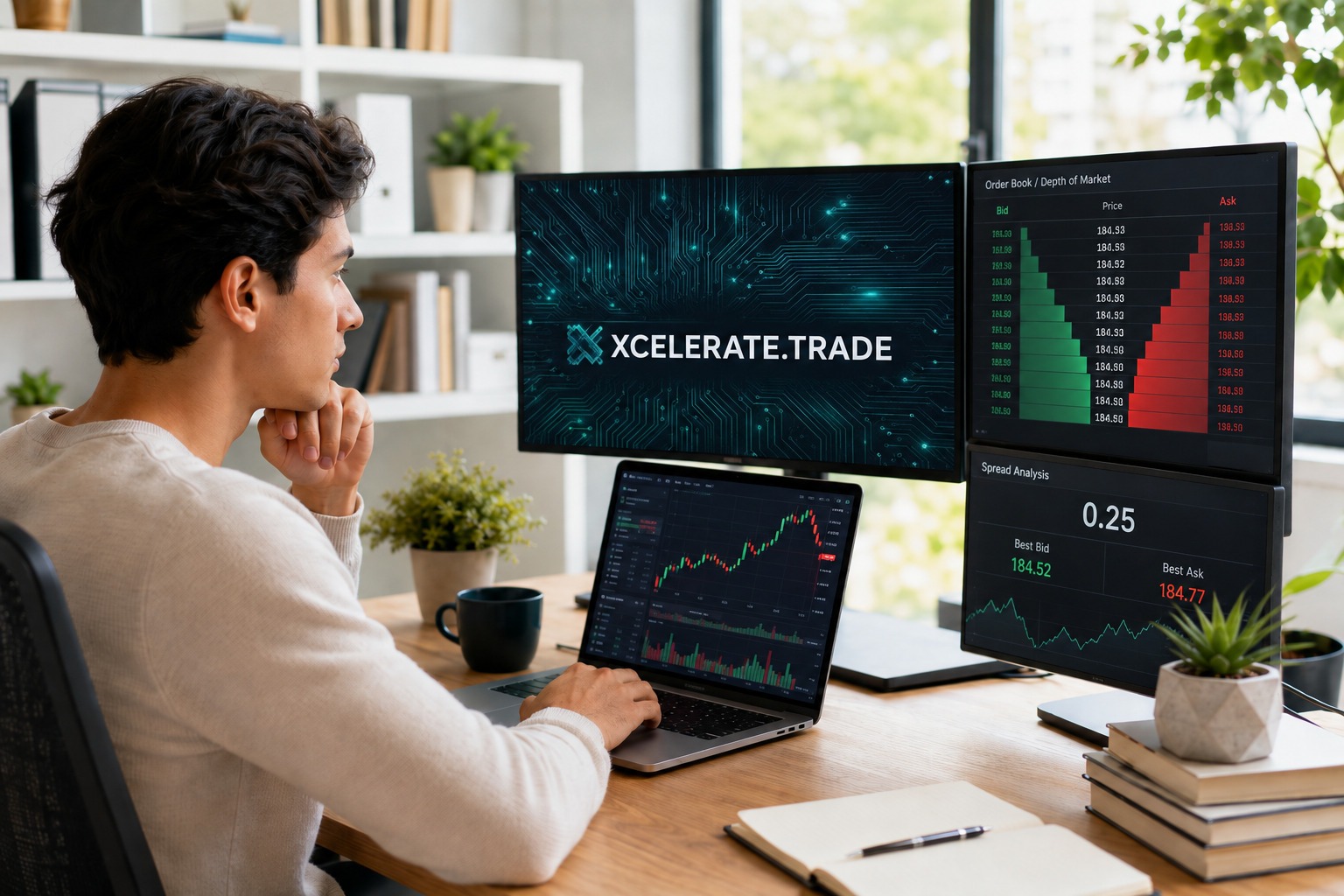
Spread is the gap between what buyers offer and what sellers ask, and it widens exactly when you would rather it did not, at the open, around news, and through thin overnight hours. Slippage is the difference between the price you clicked and the price you received. It is why a strategy that looked immaculate in backtest can bleed steadily in practice.
A beginner who learns to estimate total cost per trade before choosing an instrument sidesteps a specific trap. Fast strategies on wide spread instruments look brilliant on paper and lose money in the account. That is not pessimism, it is arithmetic, and it explains why cost awareness sits alongside strategy rather than after it.
The psychological muscles nobody warns you about
I am wary of trading psychology content, because plenty of it is vague reassurance dressed up as insight. The useful version is behavioural and specific. It treats emotional patterns as things you design around, not feelings you defeat through willpower.
Revenge trading is the obvious one. You take a loss, you want it back immediately, you take a setup that fails your own criteria, and now you own two losses and a considerably worse mood. The fix is a written rule, something like stopping after two losses in a session, not a private intention to stay calm.
Boredom is the subtler failure. Long stretches with no valid setups feel like wasted time, and the mind starts inventing patterns to justify the hours. Anyone who has traded a slow August afternoon knows this feeling far too well.
The third one is size creep after a winning run. Confidence rises, position size drifts upward without a decision ever being made, and the inevitable drawdown lands on the largest positions of your career. Keeping risk fixed while your skill grows is thoroughly unglamorous, and it is what separates the people still trading in three years.
Practising in replay before touching a demo
There is a step most beginners skip, and skipping it costs months. Replay comes before demo, because replay lets you compress time.
In replay you load historical data and step through it bar by bar, deciding without knowing what happens next. A session that took six hours in real life takes twenty minutes, which means a hundred repetitions of one specific setup can pass through your hands in a fortnight. That is how recognition actually forms, and there is no shortcut around the repetition count.
Demo trading does a different job. It teaches platform mechanics, order types, the feel of managing a live position, and the discipline of following a plan while the clock runs. It is a poor tool for building recognition, because most of the session is spent waiting.
The practice environment at Xcelerate Trade is built around that distinction, which strikes me as one of its more sensible design decisions. Replay for repetitions, demo for process, then a small live account where the amounts are real but survivable. Jumping straight to live money with a fully funded account remains the most common and most expensive mistake in this field.
Where copy trading fits as a study tool
My feelings about copy trading are mixed, and I will say why. Used as a shortcut it teaches nothing, because watching money move builds no judgement at all. Used as a study aid it is genuinely valuable.
The productive way to use it is forensic. You follow a trader’s positions and then reconstruct the reasoning behind each one, asking why that entry, why that stop distance, why that size, why they exited when they did. Half the time you will disagree, and disagreeing for a stated reason is progress.
The second honest use is calibration. Watching an experienced trader hold through a drawdown that would have shaken you out, or sit on their hands for three consecutive days, quietly resets your sense of what normal looks like. Beginners consistently overestimate how often good traders actually trade.
Reading a market’s regime before picking a strategy
Strategies are conditional rather than good or bad. Trend following in a range will chop you to pieces, and mean reversion in a strong trend does something worse. It works four times and then returns everything on the fifth.
So the skill is regime recognition, which in practice means describing the current market in one sentence before doing anything else. Is it trending with pullbacks, is it ranging between two clean levels, is it expanding after a long compression, or is it simply undefined. That last category is real and deserves respect rather than a trade.
This also cures the strategy hopping problem. Someone who understands regimes stops abandoning a method after three losses, because they can see the method had no environment to work in that week. That single realisation keeps people in the game long enough to become good at it.
What the numbers say about the first year
I am not going to pretend the base rates are cheerful. Academic work on retail day traders has been consistently sobering, including a 2020 study of Brazilian futures traders which followed people trading for at least three hundred days and found only a small single digit percentage made money, with a far smaller fraction earning more than a local minimum wage. Earlier research on Taiwanese day traders by Barber and Odean pointed the same way.
I raise it because a platform that hides this is doing beginners no favours. Those figures describe people trading without structure, without risk rules, and usually without measuring their own behaviour at all. They describe the default outcome, not a law of physics.
The realistic path looks like months of unpaid work. Roughly the first two on chart reading and replay, the third and fourth on demo with a written plan, and somewhere near month five or six a small live account where the sums are large enough to feel and small enough to survive. Consistency, defined honestly, means positive expectancy across about a hundred trades, not three good days in a row.
What the second year looks like if the first one goes well
The traders I know who made it past the beginner stage did not have a breakthrough moment. They had a dull stretch of six or eight months in which nothing dramatic happened, the journal filled up, risk stayed fixed, and the mistakes slowly got smaller.
By the second year the skills have shifted. Chart reading runs on autopilot, sizing no longer needs a calculator, and most of the effort moves to managing attention and energy across a week. The strategy itself barely changes, which surprises people who expected constant reinvention.
If I could hand a beginner one thing, it would not be a setup or an indicator. It would be the habit of writing down what they expect before it happens, then reading it back afterwards without flinching. The structure, the replay tool and the risk rules all exist to keep that habit alive long enough to work.
Questions beginners ask most often
How much time does this actually take each day
Two focused hours during a session, plus twenty minutes of review afterwards, beats eight hours of staring. Most of the improvement happens in replay and in the journal rather than in front of a live chart, so extra screen time tends to add fatigue rather than skill.
Do I need a large account to start
No, and starting large usually makes things worse. Position sizing rules work identically at any account size, and a small live balance teaches the same emotional lessons at a fraction of the tuition.
Is crypto a good place for a beginner to learn day trading
It has genuine advantages, mainly continuous hours and reliable volatility, which produce more practice opportunities per week than a market with fixed sessions. It also punishes sloppy risk management faster, so the rules need to exist before the first live trade rather than after the first painful one.
How many indicators should I use
One or two, chosen deliberately, and only to confirm something already visible in price. A moving average for context plus one momentum tool covers the first year comfortably, and adding more usually reduces clarity rather than increasing it.
What is a realistic win rate
Somewhere between fifty and seventy percent for a well executed discretionary approach, though the number matters far less than the reward to risk attached to it. Fifty percent at two to one is a solid business, while eighty percent at one to three is a slow and confusing disaster.
When should I stop trading for the day
After two losses, after a technical problem, after news that invalidates your read of the session, or the moment you notice yourself hunting for reasons to enter rather than reasons to wait. Written rules hold up better than judgement made while tired and slightly annoyed.
What is the difference between replay and demo practice
Replay compresses historical sessions so you can run a hundred repetitions of one setup in a couple of weeks, which is what builds pattern recognition. Demo runs in real time and trains platform mechanics, order handling and the discipline of following a plan while price moves against you.
Can I learn this without any structure at all
You can, and some people do, but it generally takes longer and costs more in avoidable losses. The value of a structured path is sequence, feedback and a reason to measure yourself honestly, not privileged information about where the market goes next.