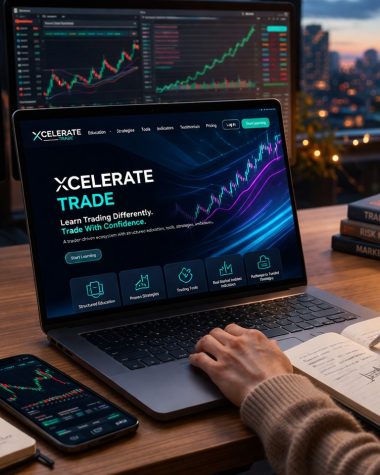

A trading platform can look strangely harmless before the market opens. A few charts sit quietly on the screen, the price barely moves, and two buttons wait for a click. Nothing about that scene suggests how quickly a bad decision can become an expensive one.
I have always found this contrast revealing. Opening a trade is ridiculously easy compared with learning how to trade responsibly. A beginner can place an order after ten minutes with a platform, yet it may take months before that same person understands position sizing, probability, emotional control and the simple value of doing nothing.
That gap between access and readiness is one of the problems Xcelerate Trade appears to be trying to address.
Its approach is built around structured education, trading practice, risk management, technical analysis and psychology. Rather than treating trading as a search for a perfect signal, Xcelerate.Trade presents it as a process in which preparation and execution matter just as much as identifying an opportunity.
I think that distinction is more important than it first sounds.
Retail traders rarely fail because they have never heard of support, resistance or stop losses. Most beginners encounter those ideas quite early. Trouble starts when knowledge remains scattered, when risk rules change after a loss, when a trade is taken out of boredom, or when a trader knows what should be done but does something else once real money is involved.
No educational platform can remove those problems completely. Markets remain uncertain and losses remain part of trading. What a structured program can try to do is reduce the number of avoidable mistakes that turn ordinary losses into something much worse.
That, more than anything else, seems to be the logic behind Xcelerate Trade.
Why Retail Traders Fail So Often
The failure rate among active retail traders has been discussed for years, sometimes with statistics used a little too casually.
European regulators have previously reported that a large majority of retail CFD accounts lose money. Separate academic research into very active trading has also found poor long term outcomes among many individual traders. Those studies involve specific products, countries and groups of participants, so I would not turn them into a universal claim that every type of retail trader faces exactly the same percentage chance of failure.
Still, the pattern is difficult to ignore.
Frequent trading is hard. Leveraged trading is harder. Trying to do either without a clear framework adds another layer of difficulty that has little to do with whether somebody can recognize a chart pattern.
I often think beginners are taught the problem backwards.
Their attention naturally goes to entry points. They want to know where to buy, where to sell and which indicator might identify the next move. The questions feel urgent because the moving chart makes everything look urgent.
Yet an entry is only one small part of a trade.
A technically reasonable setup can still become a poor decision if the position is oversized. A trader can identify direction correctly and still lose because the stop is moved repeatedly. Someone can even have a profitable method over a meaningful sample and abandon it after several losses because those losses feel like proof that the strategy is broken.
Retail trading failure is therefore partly analytical, but it is also behavioral.
That is why the educational design around Xcelerate Trade matters. It is attempting to connect knowledge about markets with rules about what a trader actually does before, during and after a trade.
Xcelerate Trade Begins With Structure
The internet has solved the problem of finding trading information and created another problem in its place.
There is too much of it.
A beginner can watch somebody trade breakouts over breakfast, learn that breakouts should never be trusted by lunchtime, discover order flow in the afternoon and finish the evening watching a video explaining why almost everything learned earlier is useless.
I know how convincing this can feel. The next method always seems cleaner because it has not yet had time to disappoint you.
A structured curriculum tries to prevent that endless hopping.
The Xcelerate Trade Academy is organized as a progressive educational program rather than a loose library of unrelated lessons. The current program moves from basic market concepts toward risk management, psychology, technical analysis, trading tools and practical execution.
That sequence is useful because beginners often encounter advanced concepts before mastering elementary ones.
Someone may learn a sophisticated liquidity model while still being unable to explain how much money is actually at risk when a stop is placed twenty points away. Another trader may spend weeks refining entries without keeping any reliable record of whether those entries perform well.
Progressive learning does not make a trader profitable by itself.
It does, however, reduce the chance that important pieces are skipped simply because another topic looks more exciting.
Understanding Comes Before Speed
Trading encourages speed long before speed is useful.
Prices move quickly. Platforms execute quickly. Social media celebrates quick decisions. The inexperienced trader soon begins to believe that hesitation itself is a weakness.
In reality, hesitation can occasionally be the most intelligent part of the process.
Xcelerate Trade uses a lesson based progression in which learners are expected to understand one section before moving deeper into the material. Knowledge checks and quizzes are included throughout the educational path.
I see those tests less as academic exercises and more as small pieces of friction.
Watching somebody explain risk is easy. Answering a question about it forces you to stop and discover whether the idea actually stayed with you.
The difference becomes much larger when money is involved.
A trader who vaguely remembers that excessive risk is dangerous may still take a huge position. A trader who has repeatedly calculated risk as part of a routine has at least built a practical habit around the idea.
Education becomes valuable when it changes behavior.
Otherwise, it is just interesting information.
The Focus Shifts From Prediction to Probability
One of the fastest ways to get into trouble in markets is to become certain.
Certainty feels good. It makes the trader decisive. It also has a habit of increasing position size at precisely the wrong moment.
I am suspicious whenever a trading method encourages the belief that enough analysis can remove uncertainty. Charts are useful, market structure is useful, economic information is useful, but none of them sends a signed promise about the next candle.
Xcelerate Trade frames trading around probability rather than certainty.
That sounds like a small difference in vocabulary, although it changes the entire relationship with a trade.
If I believe a setup must work, a loss becomes a problem requiring explanation. Perhaps the stop was too tight. Perhaps I should enter again. Perhaps the market is temporarily wrong and will soon notice.
We all know where that road can lead.
If I understand that the same setup can legitimately lose despite being well executed, the loss becomes part of the distribution rather than an insult.
A good trade can lose money.
A bad trade can make money.
That sentence takes beginners a surprisingly long time to accept because profit provides powerful emotional validation. An impulsive position that happens to win can teach a terrible lesson.
A process based approach tries to evaluate the decision before looking at the outcome.
Risk Management Has to Begin Before the Trade
A stop loss is much easier to respect before price gets close to it.
Once the market begins moving against a position, the mind becomes extremely creative. A level that looked perfectly logical ten minutes earlier suddenly appears arbitrary. Another support zone emerges a little farther down the chart.
Then another one.
This is why risk management cannot be something a trader invents while already under pressure.
Xcelerate.Trade places considerable emphasis on defining the amount at risk, the stop location and the position size before execution. Its educational material discusses percentage based risk limits and connects the distance to a stop with the size of the position.
The logic is straightforward.
Imagine a trader with a $10,000 account who decides in advance that a particular idea should expose only a small fraction of the account to loss. Once the stop distance is known, position size can be calculated so that the financial risk remains within that limit.
Now compare that with another trader who begins from the amount of profit he wants.
The second trader may choose a larger position because making $500 sounds better than making $100. Risk has quietly become a consequence of ambition.
The first trader begins with what can be lost.
The second begins with what he would like to gain.
Only one of those approaches gives the downside the first word.
Small Losses Matter More Than Dramatic Wins
Trading content naturally gravitates toward large winning trades.
They are visual. They are exciting. Nobody builds an impressive social media post around a carefully managed loss of thirty dollars.
Yet small losses may tell us more about whether a trader has a chance of staying in the game.
A disciplined loss means the trader followed the plan even when the market refused to cooperate. Nothing spectacular happened, which is exactly the point.
A dangerous trader can survive for quite a while if the market is generous.
He may use too much leverage and win. He may move stops and still escape. He may average into a bad position and watch price eventually return.
Those experiences can create confidence without creating competence.
Then one trade does not return.
A risk framework is meant to prevent a routine analytical mistake from becoming an account threatening event.
Xcelerate Trade repeatedly connects trade ideas to stop placement, position sizing and acceptable risk. In practical terms, that means being wrong is expected.
Being catastrophically wrong because the position was too large is treated differently.
Trading Psychology Is Made More Concrete
Trading psychology can become a rather fluffy subject if we are not careful.
People say traders need patience, discipline and confidence. Fair enough. A football goalkeeper also needs concentration, but telling him to concentrate harder is not much of a training program.
I prefer psychology when it can be seen in behavior.
Fear may appear as closing a position too early.
Greed may appear as increasing size after a good week.
Revenge trading may appear as entering a second position immediately after a loss even though the normal setup is missing.
Overconfidence often arrives quietly after several successful trades. The trader does not announce that he has become reckless. He simply begins giving himself more freedom.
Xcelerate Trade addresses psychology in this practical sense.
Its training material discusses unrealistic expectations, overconfidence, drawdowns, revenge trading, fatigue and emotional decision making. It also treats stepping away from the market as a legitimate response when the trader’s mental state is interfering with execution.
I like that last part.
Retail trading culture tends to glorify participation. People sit in front of a screen and feel they ought to do something because they have allocated time to trading.
The market has no obligation to provide a suitable opportunity merely because somebody has cleared the afternoon.
Learning not to trade can therefore be as important as learning how to enter.
No Trade Can Be the Correct Trade
Imagine sitting at a desk for two hours and closing the platform without placing an order.
A beginner may interpret that session as wasted time.
An experienced trader may see it as evidence that the rules worked.
This difference in perspective is crucial.
When a trader begins a session already expecting to trade, analysis becomes subtly biased. The question stops being whether a valid opportunity exists and becomes whether the current chart can somehow be persuaded to qualify.
Weak confirmations begin looking stronger.
A mediocre entry starts feeling good enough.
Xcelerate.Trade uses defined setup criteria and confirmations as a way of filtering opportunities before execution. Its strategy education includes market structure concepts, liquidity, changes in market behavior and other contextual tools that are meant to work together rather than as isolated signals.
I would not treat any of those concepts as guarantees.
No technical framework deserves that status.
Their practical value comes from forcing the trader to answer a series of questions before money enters the market.
If the required conditions are absent, doing nothing remains an acceptable decision.
That sounds simple. In real trading, it can be surprisingly difficult.
Why Focusing on Fewer Markets Can Help
Beginners often behave like tourists with very little time.
They want to see everything.
Gold moves, so they watch gold. The Nasdaq becomes active, so another chart opens. A currency pair begins trending and receives immediate attention. By evening, Bitcoin has joined the party.
The trader has spent all day looking at markets and may still know none of them particularly well.
Xcelerate Trade encourages a more focused approach, particularly during the learning stage.
Working repeatedly with one or two instruments gives the trader a chance to become familiar with how those markets tend to behave during different sessions and around major events.
That familiarity does not create certainty.
It creates context.
After watching the same instrument for weeks, certain movements stop looking dramatic. The trader begins noticing how quickly it usually travels, where volatility tends to expand and when conditions feel unusually thin or aggressive.
Some of that knowledge can be measured. Some of it is simply accumulated observation.
Both are difficult to develop when the instrument changes every hour.
Demo Trading Gives Mistakes a Lower Price
Nobody becomes emotionally prepared for live trading simply by practicing on a demo account.
That limitation should be said plainly.
Losing simulated money is not the same experience as watching part of your salary disappear from a real account. Live conditions can also involve execution differences, spreads and slippage that a simulation may not reproduce perfectly.
Even so, demo practice solves a different problem.
It allows mechanical mistakes to happen without charging full tuition.
A beginner needs to know how to place an order, set a stop, calculate position size, close part of a position and confirm the correct instrument. These are basic tasks, yet they become surprisingly awkward when price is moving quickly.
Xcelerate Trade integrates practice into its learning process rather than treating live trading as the obvious first step after watching lessons.
That seems sensible to me.
The purpose of demo trading is not to prove that somebody can make money in an environment where nothing emotionally important is at stake.
It is to remove unnecessary confusion before real emotional pressure is introduced.
Execution Is a Skill of Its Own
A trader can spend forty minutes planning and destroy the plan in twenty seconds.
Wrong instrument.
Wrong size.
Wrong order type.
Stop entered at the wrong price.
These mistakes are painfully mundane, which is exactly why they are easy to underestimate.
Xcelerate.Trade teaches chart analysis and execution as related but distinct parts of the workflow. Its material uses common trading platforms and stresses the importance of verifying the instrument and order details rather than assuming every symbol or contract behaves identically.
Professional habits often look boring from the outside.
Pilots use checklists. Surgeons verify details that appear obvious. Traders benefit from the same suspicion toward small mechanical errors.
The market already supplies enough uncertainty.
There is no reason to manufacture additional uncertainty by clicking carelessly.
Major News Changes the Risk Environment
A technically attractive chart can become useless in seconds when a major economic release arrives.
Price jumps. Spreads may widen. Execution can become less predictable. The neat little structure visible before the announcement can disappear almost instantly.
Xcelerate Trade includes economic news as part of risk preparation.
The goal is not necessarily to predict the outcome of every inflation report or central bank meeting. An intraday trader does not need to become a professional economist to understand that certain events alter market conditions.
That recognition alone can prevent avoidable trades.
Checking a calendar before a session is mundane work.
So is checking the weather before leaving home.
Both become interesting only after somebody forgets.
Unrealistic Expectations Can Break a Good Process
Financial pressure changes the meaning of a trading setup.
If a trader needs to make money today, a merely acceptable setup begins to look excellent.
If rent depends on Friday’s result, waiting becomes psychologically difficult.
This is one reason I think discussions about trading income should come much later than discussions about risk.
Xcelerate Trade addresses unrealistic expectations and the danger of forcing trades to reach financial goals. Its educational approach separates learning the process from expecting trading to immediately replace ordinary income.
That separation matters.
A trader with outside income can sometimes afford to leave a poor session alone.
A trader who believes the market owes him two hundred dollars before dinner may find a reason to keep clicking.
Pressure does not improve market conditions.
It merely changes the standards by which the trader judges them.
Indicators Should Help a Process, Not Become the Process
Indicators are attractive because they make uncertainty look organized.
A line changes color.
A box appears.
A signal prints on the chart.
Suddenly, a messy market seems to be saying something clear.
Xcelerate.Trade offers technical tools and indicators, but its educational material generally places those tools inside a broader analytical framework. The emphasis is on using them as support rather than allowing an indicator to replace the decision process entirely.
I think that distinction is healthy.
A tool can highlight market structure or make certain conditions easier to see.
It cannot decide whether the trader is tired.
It cannot stop somebody from doubling risk after a loss.
It cannot determine whether the trader is following the plan for the right reason or merely searching for an excuse to enter.
Tools are good at reducing visual work.
They are much less impressive at controlling human behavior.
Strategy Hopping Creates the Illusion of Learning
A few losses can make a new strategy look broken.
Another method suddenly seems more appealing, usually because the trader has not experienced its bad period yet.
This cycle can continue for months.
The trader is constantly learning something new and gathering almost no reliable evidence about anything.
Xcelerate Trade encourages traders to think in terms of a repeatable process rather than changing methods whenever short term results become uncomfortable.
A strategy cannot be evaluated sensibly if the rules keep moving.
Data needs consistency.
If entries, markets, timeframes and risk change every week, the trader may have a large trading history while possessing very little useful information.
A losing streak certainly deserves attention.
It does not automatically prove that the underlying approach has stopped working.
Sometimes the hardest thing a trader can do is collect enough evidence before reaching a conclusion.
Rules Can Protect Traders From Their Best Excuses
People often imagine discipline as a character trait.
I prefer to think of it as an environment.
The easier it is to break a rule, the more often the rule will eventually be broken.
Xcelerate Trade introduces several kinds of friction into the decision process through structured lessons, defined setup conditions, risk calculations and pre-trade preparation.
Each one creates a moment in which an impulse can be questioned.
Does the setup actually meet the criteria?
Is the stop where the original analysis says it should be?
Is the position size consistent with the planned risk?
Is major news about to be released?
Am I trading because the opportunity is present, or because I am annoyed that the previous trade lost?
Those questions are not sophisticated.
That is part of their usefulness.
Trading mistakes are often quite ordinary.
Prop Firm Capital Does Not Fix an Undisciplined Trader
The growth of prop firm challenges has given retail traders another tempting shortcut.
A large account number looks like progress.
Sometimes it merely magnifies the same old habits.
Xcelerate.Trade includes education around prop firm style evaluations and the risk limits attached to them. The emphasis is on understanding drawdown rules, daily loss limits and the danger of changing behavior simply because a profit target is nearby.
This becomes especially important during evaluations.
A trader who is close to a target may increase size to finish more quickly.
Someone approaching a loss limit may begin trading aggressively in an attempt to recover.
Both reactions are understandable.
Both can ruin an otherwise disciplined evaluation.
Access to more capital does not correct poor risk management.
Usually, it makes the consequences more visible.
Why the Whole System Matters More Than a Single Trading Strategy
The part of Xcelerate Trade that interests me most is not one indicator or one technical setup.
It is the attempt to connect several ordinary disciplines that traders often learn separately.
A beginner may discover chart analysis first.
Risk management appears later, usually after a painful lesson.
Psychology becomes interesting after revenge trading.
Journaling becomes important once the trader can no longer remember why half the positions were taken.
By then, bad habits may already feel normal.
Xcelerate Trade’s educational model tries to place these pieces together earlier.
The learner studies how markets work, how risk should be controlled, how trades can be filtered, how execution works and how emotional behavior can disrupt the whole arrangement.
None of those subjects is particularly revolutionary on its own.
Their value lies in being connected.
A trading plan is only useful when its parts agree with one another.
What Xcelerate Trade Can and Cannot Claim
Here I think precision matters.
A well structured educational system is not the same thing as proof that traders using it will succeed.
As of the public information available in 2026, Xcelerate Trade describes a framework intended to improve trader preparation, risk awareness and execution. I have not seen independently audited public evidence showing that people who complete the program achieve a specific reduction in failure rates compared with a similar group of traders who do not use it.
That does not make the educational model irrelevant.
It simply places the claim where it belongs.
Xcelerate.Trade can reasonably describe how its system is designed to address common causes of retail trader failure. Demonstrating that it has already reduced those failures by a measurable percentage would require reliable outcome data collected over time.
I would actually like to see that kind of research.
Completion rates, changes in risk behavior, frequency of rule violations, consistency in simulation and longer term trader survival would all provide useful information.
Until then, the strongest case for the platform is the logic of the process rather than a promised success rate.
I find that more credible anyway.
Markets are crowded with certainty. A little restraint is refreshing.
The Real Goal Is Not to Avoid Losing Trades
Every serious trader loses.
That fact is easy to say and much harder to accept once the loss is yours.
The practical goal of trading education is therefore not to eliminate losing positions.
It is to stop ordinary losses from triggering extraordinary behavior.
A trader who takes a planned loss, records it and waits for the next qualified setup has experienced one kind of failure.
A trader who responds by increasing size, abandoning the stop and entering three impulsive positions has experienced another.
The market caused the first loss.
The trader created much of what followed.
Xcelerate Trade seems primarily designed to work on that second category.
Its emphasis on structured learning, defined risk, repeatable setups, practice and psychological discipline attempts to reduce the number of decisions made in the heat of the moment.
That is probably where education has its greatest chance of helping.
How Xcelerate Trade Aims to Reduce Retail Trader Failure
Put simply, Xcelerate Trade tries to make retail trading more deliberate.
The program teaches traders to build knowledge in sequence before advancing to more complex material. It encourages risk to be calculated before entry, uses practice to develop execution habits, introduces technical filters to reduce impulsive trades and treats emotional control as a practical part of the trading process.
Xcelerate.Trade also encourages realistic expectations.
The trader is not taught that every session requires a position or that every loss represents a broken strategy. Trading is presented as probabilistic work in which capital preservation and consistency matter.
None of this guarantees profitability.
A disciplined trader can still lose money. A sound strategy can go through poor periods. Market conditions can change faster than a trader adapts.
The difference is that losses inside a controlled framework are easier to survive and easier to study.
That is a far more realistic way of thinking about reducing trader failure.
The objective is not to turn uncertainty into certainty.
It is to stop uncertainty from turning into chaos.
I picture the useful version of this lesson in a fairly ordinary room. A trader has been watching the market for forty minutes. Price reaches an interesting area, but one of the conditions in the plan is missing.
For a moment, the mouse moves toward the order button.
Then it stops.
Nothing appears in the trading history that day. Oddly enough, that may be one of the clearest signs that the education is beginning to work.
Frequently Asked Questions
How does Xcelerate Trade aim to reduce the failure rate of retail traders?
Xcelerate Trade aims to address several common reasons retail traders struggle, including poor risk management, inconsistent strategies, emotional decision making, inadequate preparation and impulsive execution. Its educational model combines structured learning with trading practice, technical analysis, psychology and predefined risk rules.
The basic idea is to make trading decisions more systematic. Rather than trying to remove losing trades, the approach seeks to reduce avoidable mistakes that can turn normal trading losses into much larger problems.
Does Xcelerate Trade guarantee that traders will become profitable?
No. Trading education cannot guarantee profitability, and market outcomes remain uncertain regardless of the strategy or educational program used.
The more reasonable purpose of the Xcelerate Trade approach is to improve how a trader prepares, controls risk and follows a process. Better habits may reduce preventable errors, but they do not eliminate market risk.
Why is risk management so important for retail traders?
Risk management determines how much damage a losing trade can cause.
A trader can have a strong market idea and still suffer a serious loss if the position is too large. By deciding the acceptable loss before entering and adjusting position size accordingly, traders can keep individual mistakes from placing a disproportionate amount of capital at risk.
Xcelerate.Trade makes this relationship between stop placement, position size and account risk an important part of the learning process.
Why does Xcelerate Trade emphasize demo trading and practice?
Demo trading allows beginners to learn basic execution without exposing meaningful capital to simple mechanical mistakes.
It gives traders room to practice order placement, stops, position sizing and platform use before real money introduces stronger emotional pressure. A demo environment cannot perfectly reproduce live trading, but it can make the early learning process less expensive.
How does trading psychology affect retail trader performance?
Psychology affects the decisions traders make after uncertainty becomes uncomfortable.
Fear can cause profitable trades to be closed too early. Overconfidence can lead to larger positions after a winning streak. Frustration may lead to revenge trading, while financial pressure can make weak setups appear more attractive than they really are.
Xcelerate Trade treats these behaviors as part of execution rather than as abstract personality traits. The aim is to help traders recognize conditions in which they are more likely to abandon their rules.
Why can taking no trade be a good decision?
A trading plan only works if the trader is willing to wait for its conditions.
When no suitable setup appears, opening a position simply to remain active adds unnecessary risk. Treating no trade as an acceptable outcome helps prevent boredom, impatience and the feeling that every session must produce money.
For many beginners, learning to stay out of the market is one of the most difficult forms of discipline.
Does Xcelerate Trade rely only on indicators?
No. The educational approach places indicators and technical tools inside a wider decision process.
Market structure, context, risk, execution and psychology remain important. An indicator may help organize information or highlight a potential condition, but it cannot decide whether a trader is using excessive risk or entering because of frustration.
Can Xcelerate Trade eliminate losing trades?
No educational program can eliminate losing trades from a probabilistic market.
The more realistic goal is to make losses manageable and prevent one poor outcome from producing a chain of emotional decisions. A controlled loss that follows the trading plan is very different from a large loss caused by excessive leverage or abandoned risk rules.
Is Xcelerate Trade suitable only for experienced traders?
Its structured learning approach is particularly relevant to beginners because it starts with foundational concepts before moving toward more advanced analysis and execution.
More experienced traders may also find value in reviewing their risk process, psychological habits and consistency. Experience alone does not necessarily remove bad habits, especially if those habits have never been measured carefully.
What is the main idea behind the Xcelerate.Trade approach?
The main idea is that trader survival depends on more than finding good entries.
Education, risk limits, repeatable setups, practice, emotional control and realistic expectations need to work together. Xcelerate.Trade tries to turn those elements into a coherent routine so that trading decisions are made according to a process rather than the mood of a particular moment.
Can structured trading education really lower trader failure?
Structured education can address behaviors that frequently contribute to poor trading outcomes, such as oversized positions, inconsistent execution and impulsive decisions. That gives it a plausible role in reducing avoidable mistakes.
However, proving that a particular educational program lowers the overall failure rate requires reliable long term outcome data. For Xcelerate Trade, the public case currently rests more clearly on the design of its educational process than on an independently verified reduction in trader failure rates.
What should a beginner learn before risking real money?
A beginner should understand how the chosen market works, how position size affects account risk, how stop losses are used and how orders are executed. The trader should also have a repeatable setup and a clear idea of what conditions would make staying out of the market the better choice.
Perhaps most importantly, these decisions should be familiar before money creates urgency. The chart becomes a very different object once every movement has a financial consequence.