
There is a folder on my laptop I never show anyone. It holds screenshots people have sent me over the years, mostly account balances heading the wrong way, usually attached to a message that begins with “I don’t understand what happened.” Almost none of those people were reckless. They were curious, they had a bit of money saved, they opened a broker account on a Tuesday and were placing trades by Wednesday.
That folder shapes how I read a question like this one. When somebody asks whether a platform works for a complete beginner, the real question underneath is narrower and far more useful. Will it slow me down long enough to stop me doing something expensive, and will it teach me anything true while it does?
Here is what I found looking at Xcelerate Trade through that filter, including the parts I would want a friend to know before paying for anything.
What beginner friendly has to mean in trading
In most software, beginner friendly means the buttons are obvious. In trading, that definition runs backwards. A platform that makes your first trade effortless is not helping you, it is handing car keys to somebody who has never sat behind a wheel.
The beginner’s real enemy is speed of access, not a shortage of features. Every broker alive will let you fund an account and trade the same day. Very few will structure the months that should come first, which is exactly where the learning has to happen.
So my test for any platform aimed at people with zero experience comes down to three things. Is the curriculum sequenced, is there a way to practise that costs only time, and does anything measure whether you are actually improving. Everything else is decoration.
The gap between knowing and doing
Something took me two years to understand. You can read every book on technical analysis ever written and still freeze the moment a position moves against you. Knowledge and execution sit in different parts of the brain, and only one of them responds to reading.
I watched a friend who had memorised half a dozen chart patterns open a trade, see it dip forty euros, and close it in a small panic. Two hours later the setup resolved exactly as his book promised. His analysis was fine. His hands were the problem.
That gap is why a practice environment beats a content library. A course can tell you what a stop loss is. Only repetition teaches you to leave one alone.
How the Academy handles the learning order problem
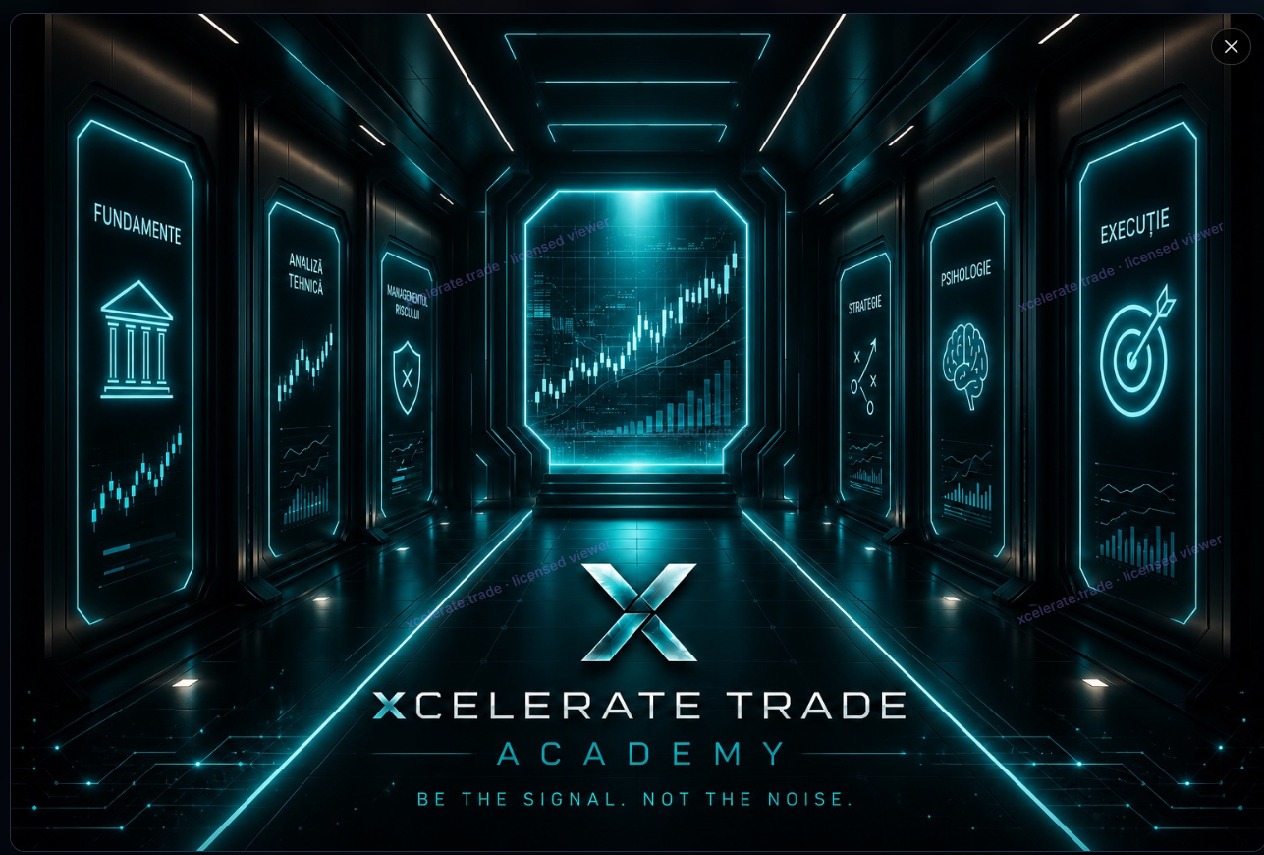
The Xcelerate Trade Academy is built as a structured program of roughly ten chapters and about seventy lessons, running from core concepts and capital management through analysis, psychology, and applied strategy. On paper that is a lot of hours. In practice the sequencing matters more than the volume, because a beginner’s problem is almost never a shortage of information. It is the absence of an order to take it in.
Every one of those topics exists free on YouTube. What does not exist free is somebody telling you that position sizing comes before indicators, and that psychology is not a soft chapter tacked on at the end but the thing that decides whether the previous nine chapters were worth reading at all. Learning order is badly underrated.
The Academy splits into tracks rather than one long queue, which suits people arriving with a specific goal in mind. There are separate paths for scalping, crypto, traditional markets, prop trading, copy trading, bot trading, risk management and trading psychology. Someone starting from nothing should probably ignore that menu for a while and begin at the beginning, but the structure is waiting when it becomes useful.
Seventy lessons sounds heavy, and it should
The day trading track alone runs to roughly twenty seven and a half hours of material. I have watched people meet that number with relief and others meet it with dread, and both reactions tell you something about readiness.
If twenty seven hours feels like too much to sit through before risking money, the mismatch is not with the course. It is with the belief that this is a quick skill. Nobody expects to rewire a house after a weekend course, yet trading somehow gets treated as something you can absorb over a long lunch.
I would much rather a beginner spend a month irritated by how slow the material feels than lose eight hundred euros in a fortnight learning the identical lessons the expensive way.
Practice is where the platform earns its keep
The section I would push a newcomer toward first is Practice, not Academy. Xcelerate.Trade gathers demo trading, replay mode, structured challenges, prop style evaluations, community competitions and a performance journal into one area, and that combination sits close to what I would build if somebody asked me to design a beginner’s on ramp from scratch.
Demo trading is the familiar piece. You trade live markets with virtual capital while following a plan, so you get the timing and the noise of a real session without paying for your mistakes.
Replay mode is the one most beginners have never heard of, and the one I would defend hardest. It plays back historical sessions so you can work through entries and exits with no live pressure, which turns a year of market hours into something you can compress into a few weekends.
Why replay beats demo in the first few weeks
Demo trading carries a structural weakness that nobody mentions. It moves at real speed, so a beginner might see three or four decent setups across an entire week. That is nowhere near enough repetition to build a reflex.
Replay fixes the arithmetic. Fifty instances of the same setup inside two sessions is how recognition stops being conscious work. It is roughly the difference between studying a language and speaking it badly to an actual person.
The catch is real, though. Replay lets you cheat, because you know the candle in front of you is history, you can pause, you can restart the session when you make a mess of it. Nobody can enforce that discipline except you.
The journal nobody wants to keep
Built into the Practice area is a performance journal, meant for reviewing trades, spotting repeated mistakes and tracking progress over time. I would bet money it is among the least used features on the platform, because journals always are.
I kept one for eleven days, gave up, then spent three months repeating an entry mistake I would have caught in week two. The pattern was not subtle either. I was entering early on strong moves because I was scared of missing them, and it took a mentor twenty minutes with my trade history to name something I had lived through forty times without seeing.
That is the part I would underline. A journal is not admin. It is the only mechanism that converts your losses into information instead of noise.
Where intraday trading fits for an absolute beginner
Now the part I have been circling. The platform runs a dedicated Day Trading track built around intraday setups, session timing and closing positions inside the trading day, and the honest question is whether somebody with no experience should aim at it at all.
My answer is a qualified yes, with the qualification carrying most of the weight. Studying the intraday material early is useful, because session structure and execution speed expose things that slower timeframes hide. Trading intraday with real money early is a completely different proposition.
Intraday is the most punishing timeframe a beginner can pick. Costs recur constantly, decisions arrive faster than judgement develops, and the feedback loop is tight enough that you can teach yourself a false lesson in a single afternoon. Swing timeframes are kinder to both your account and your sleep.
So I would treat the track as education, treat demo and replay as the sandbox, and keep real intraday money away until the journal shows something resembling consistency. That is not the platform’s rule. It is mine, and I apply it everywhere.
The numbers every beginner should see before they start
This is the part most content in this industry quietly skips, which is precisely why it belongs in the middle of the article rather than in small print at the bottom.
Day trading has been studied properly, and the findings are sobering. The well known research on the Taiwanese market by Barber, Lee, Liu and Odean found that only a tiny fraction of day traders were consistently profitable over time. A separate Brazilian study of retail futures day traders, run out of FGV, tracked people who persisted for hundreds of trading days and found roughly three percent made any money at all, with about one percent earning more than the local minimum wage.
European brokers offering leveraged products must publish the share of retail accounts that lose money, and those disclosures typically land somewhere in the seventies or eighties. They cover contracts for difference rather than every kind of trading, but the direction of the evidence has been consistent across markets and decades.
None of that makes learning pointless. It means the base rate is harsh, and any platform, course or article that lets you forget it is doing you a disservice. Xcelerate Trade positions itself as education and practice infrastructure, which is the right side of that line, though no curriculum bends the statistics for somebody who skips the practice and heads straight for a funded account.
The token model and what it means when you are new
Now for the part that will affect a beginner’s wallet most, and it is not what the marketing leads with.
Access to Xcelerate.Trade is organised around $XLR, the platform’s own token. Membership works through staking, with Silver at fifteen thousand $XLR for one year, Platinum at thirty thousand for two years and Diamond at seventy five thousand for three years, each tier opening up more strategies, indicators and marketplace access than the one below. There is also a lighter route, where you unlock an individual strategy, indicator or playbook with a one time $XLR payment instead of committing to a tier.
Worth knowing before you build expectations, the day trading track itself sits at the Diamond access level.
Why a token gate changes the calculation
A subscription priced in euros has one variable, which is whether the content justifies the money. A token gate has two, because the value of what you staked moves independently of whether the teaching was any good.
If the token appreciates, your access turned out cheap. If it falls, you paid more in real terms than the sticker implied, and an attractive staking APR does not remove that exposure. For somebody who has never traded, taking on token price risk in order to learn risk management is an odd first move, and I say that without any hostility toward the model.
Individual unlocks strike me as the sane way in for a newcomer. Buy access to the one thing you need, find out whether the teaching style suits you, then consider a multi year staked tier once you have evidence you will actually use it.
Read the labels on the roadmap
Several parts of the ecosystem are openly marked as preview or coming soon rather than live. Pools and lending carries a preview label, governance is described the same way, prop evaluations point to functionality arriving once integrations go live, and the staking checkout is listed as not yet open.
I do not read that as a warning sign. Building in public is normal, and stating plainly what is unfinished beats the alternative. Still, if a specific feature is your reason for joining, check whether it exists today or lives on a roadmap, because those are very different purchases.
Who I would actually point toward this
Somebody who wants a sequenced curriculum and a place to practise without risking money, who is comfortable with crypto mechanics like wallets and tokens, and who has the patience to spend months in demo and replay before funding anything. That person gets real value from Xcelerate.Trade, and the practice tooling beats what most beginners assemble for themselves.
Somebody who does not want to touch tokens, who would rather pay a broker in euros with a card, or who hopes to be profitable by next month. That person should look elsewhere, not because the platform is weak but because the expectations and the payment model do not match.
There is a third group worth naming out loud. If you are drawn to this because you need the money, please do not. Trading under financial pressure is the most reliable way to lose whatever is left, and no academy corrects for that.
A realistic first three months
Starting from zero, my first month would be Academy and replay only, with no demo trading whatsoever. Learn the vocabulary, work through the risk chapters properly, and spend the practice hours replaying sessions to build recognition rather than chasing virtual profit.
Month two brings demo trading, a written plan, and a hard rule that every trade goes into the journal with a stated reason for entry and exit. Ignore the balance entirely. The only metric that counts at this stage is whether you followed your own rules.
Month three is review. Read your journal the way a stranger would, find the two mistakes you keep repeating, and design rules that make them structurally harder to commit. Finish that quarter with a documented process and evidence you can follow it, and only then would I discuss real capital, in an amount you would genuinely not miss.
What suitability comes down to in the end
No platform can make somebody a trader. It can make the path less chaotic and the early mistakes cheaper, and measured against that narrow standard this one does more than most. A sequenced academy, replay, demo and a built in journal is a sensible answer to the way beginners actually fail.
The friction sits elsewhere. Token gated access means your entry cost floats with the token, several components still carry a coming soon label, and the market remains a place where most retail participants lose money regardless of how well they were taught.
Go in expecting a slow, unglamorous apprenticeship that might take a year to produce anything, and you will probably find this useful. Go in expecting a shortcut and nothing will save you, which is roughly what that folder of screenshots keeps telling me.
Frequently Asked Questions
Can I use Xcelerate Trade with no trading knowledge at all
Yes. The Academy begins at core concepts and assumes no prior experience, moving through capital management, analysis and psychology before it reaches applied strategy, so a genuine beginner is never dropped into advanced material on day one. What it cannot remove is the time cost, and the day trading track alone runs to about twenty seven and a half hours.
Do I need real money to start learning
Not for the learning and practice side of it. Demo trading uses virtual capital on live markets and replay mode works on historical sessions, so you can build and test a process before funding anything. Access to the platform itself runs through $XLR, which is a separate cost from the capital you eventually put at risk.
Is day trading realistic for a beginner
Realistic to learn, yes. Realistic as a near term source of income, no, and the research says so consistently across different countries and decades. Treat intraday as the most demanding version of the skill rather than the entry point, and build your process on slower timeframes and in simulation first.
How is this different from learning free on YouTube
Sequencing, practice tooling and measurement, mostly. Free material is plentiful and often good, but it arrives in random order with no way to check whether you are improving, and the gaps in a self assembled curriculum tend to be the unglamorous parts like position sizing and risk that decide whether you survive. A structured path combined with replay, demo and a journal closes that loop.
What does access cost
Membership runs on staked $XLR across three tiers, with Silver at fifteen thousand tokens for one year, Platinum at thirty thousand for two years and Diamond at seventy five thousand for three years. Individual strategies, indicators and playbooks can be unlocked separately with a one time token payment, which is the lighter way in. Because pricing is denominated in the token, the real cost in euros depends on the token price when you buy.
Which parts of the platform are live today
Academy, Practice and the strategy and marketplace sections are the working core, while pools and lending, governance, prop evaluations and the staking checkout have carried preview or coming soon labels. Anyone joining for one particular feature should confirm its current status first, since a roadmap item and a live product are very different things to pay for.
How long should I practise before trading real money
Longer than feels comfortable. A reasonable structure is a month of study and replay, a month of demo trading with a written plan and a journal entry for every trade, and a month spent reviewing that journal for repeated mistakes. Real capital makes sense only after there is documented evidence that you can follow your own process, and even then in an amount whose loss would not hurt.
What is the single biggest mistake beginners make here
Skipping the boring parts. Risk chapters, position sizing and the journal are what separate people who are still trading in two years from people who quit in six weeks, and they are precisely the sections that get rushed because they produce no immediate excitement.