
I have a shelf at home with five trading books on it, and for years almost every one of them had a bookmark stuck somewhere around page ninety. That’s roughly where reading stopped helping and the gap between theory and a real chart started to show. You understand the words, you nod along, and then a live candle prints and nothing you read seems to apply.
Xcelerate Trade connects knowledge, practice, and incentives by putting them in one sequence. The Academy teaches the concepts, the Practice area (replay, demo trading, challenges, a performance journal) tests them under rules, and the $XLR token unlocks premium playbooks, tools, and community features as you progress. Each layer is built to feed the next.
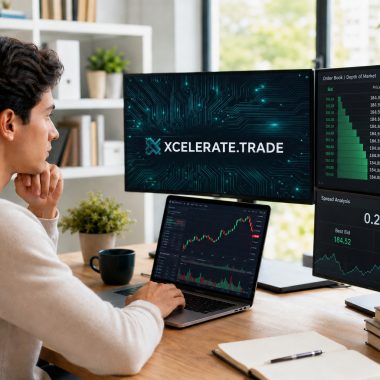
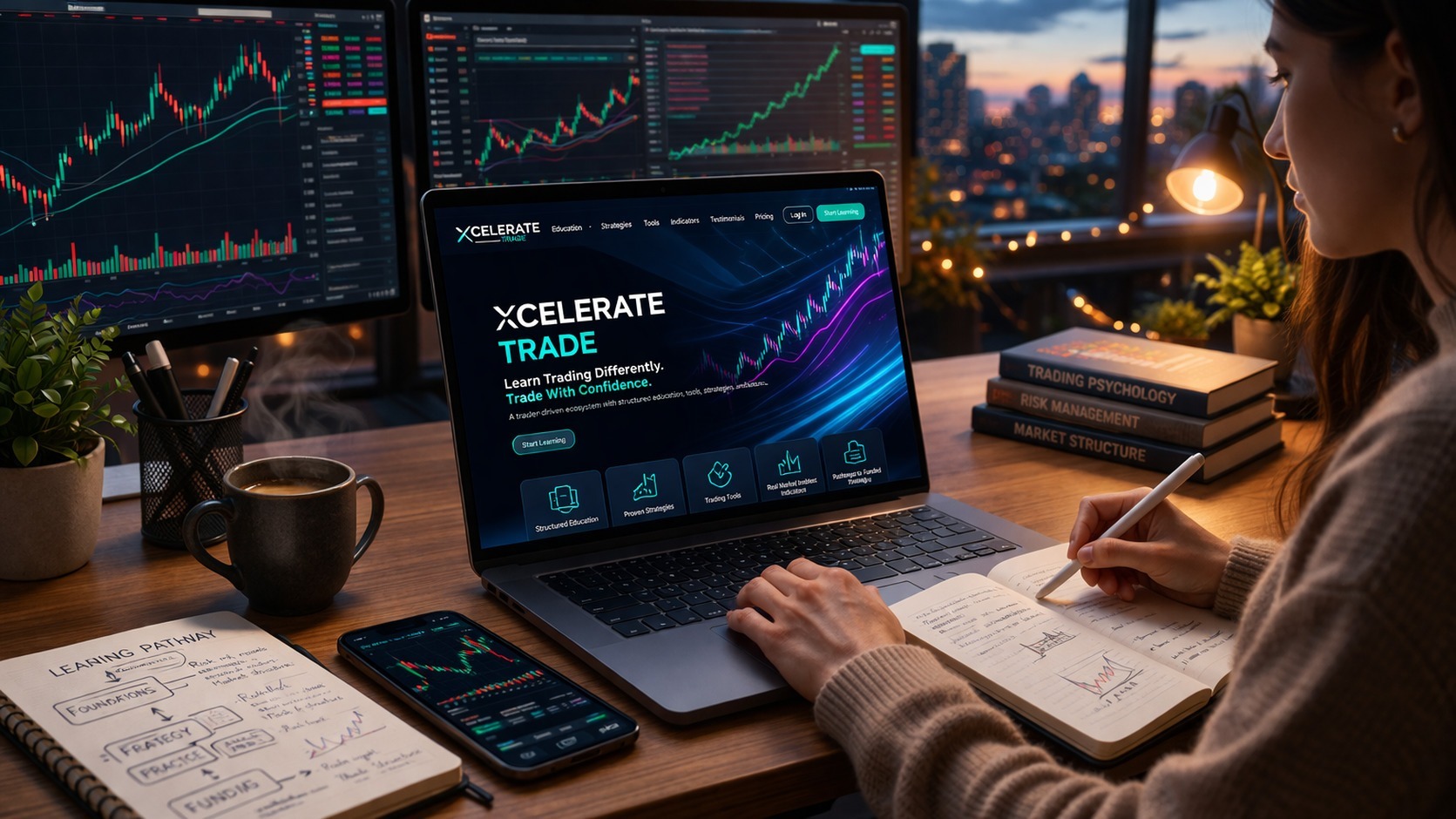
For anyone who hasn’t come across it yet, Xcelerate Trade is an online trading education platform that groups a structured Academy, practice environments, strategy playbooks, a marketplace, and community governance around its $XLR token, with content in English, Spanish, French, and Romanian. I went through it section by section over a few weeks, mostly out of curiosity about whether the pieces actually talk to each other or just sit on the same menu.
What follows is my reading of the whole thing, unfinished corners included, with a couple of spots where I’d tell a beginner to slow down. I’ll also bring in some research on how people learn skills with fuzzy feedback, because trading is about the purest example of that I know.
Why Trading Education Usually Falls Apart
Trading education tends to fall apart because knowledge, practice, and motivation are usually sold separately, by different people, with nothing tying them together. You buy a course in one place and open a demo account somewhere else, while the motivation comes from a feed full of screenshots. Those pieces never talk to each other.
I fell into that pattern myself. I’d watch a video on support and resistance, feel clever for an afternoon, then open a demo account and take trades that had nothing to do with the video. Nobody checked. The demo account didn’t know what I’d studied, and the course didn’t know what I’d done with it.
The old trading floor had it figured out
The funny thing is that trading used to have a pretty good apprenticeship model. On the floors of exchanges like the Chicago Board of Trade, founded in 1848, young people often started as runners or clerks. They carried order slips, watched the pit for months, and learned the hand signals long before they were allowed to risk a cent of their own.
That setup bundled all three things almost by accident. Knowledge came from the senior traders standing next to you, and practice came from being in the room every day. The incentive was simple, a seat on the exchange at the end. It was slow and far from fair to everyone who wanted in, but the pieces were connected.
What got lost when trading moved online
When retail brokerage moved online in the late 1990s, the apprenticeship disappeared overnight. Anyone with a modem could place an order, and nobody stood behind them saying “not yet.” Access got wildly better, which I’d never argue against, but the structure that used to protect beginners from themselves quietly went away.
Other fields kept that structure. Pilots log simulator hours before they ever fly passengers, a habit that traces back to the Link Trainer that Edwin Link built in 1929, and doctors spend years in residency. Retail trading, for some reason, mostly skipped this step, and that’s the hole Xcelerate.Trade is trying to fill.
The Knowledge Layer, Where the Academy Fits
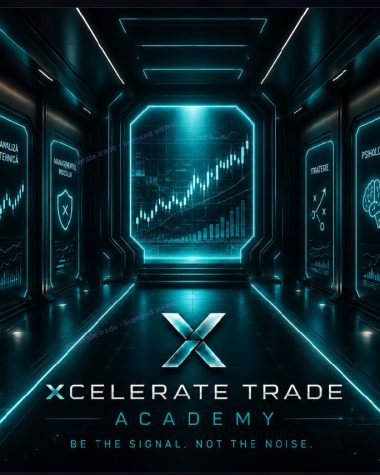
The knowledge layer at Xcelerate Trade is the Academy, a set of learning paths that move from general concepts toward risk, psychology, and market foundations. It’s presented as the starting point for people who are new or still filling gaps, and you can take it at your own pace. Nothing pushes you to the next chapter before you’re ready.
The early chapters cover things that sound almost too basic, like what you actually need before your first trade, how trading differs from investing, and how the platform itself approaches market analysis. I’ll admit I rolled my eyes at the investing lesson at first. Then I realized I’d been mixing the two mindsets for years, holding losing “trades” as if they were long-term investments, so maybe the eye roll was premature.
Short lessons on purpose
The lessons are short, and I think that’s deliberate. A long video gives you the feeling of progress without much of the substance, while a short lesson followed by a task leaves you nowhere to hide. You either understood the idea well enough to use it or you didn’t.
The home page actually suggests keeping notes while you study, specifically on how much you’ll risk and what you’ll do if the chart moves against you. It’s a tiny instruction, easy to skip. I’d argue it’s the most practical sentence on the whole site, because those two notes become the first lines of a trading plan.
Risk comes before setups
What I liked most is the order of things. Risk and psychology sit right next to foundations instead of being tucked away at the end like a disclaimer. Most free content online does the opposite, opening with the exciting entry pattern and getting to position sizing somewhere around episode twelve, if ever.
The practical effect is that you learn to ask “how much could this cost me?” before “where do I get in?” That one shift changes how every later lesson lands. A breakout pattern looks very different when you already know you’ll only put a small, fixed slice of your account behind it.
The Practice Layer, Where Ideas Meet Rules
The Practice section is where Xcelerate.Trade turns lessons into repetitions, through replay sessions, demo trading with virtual capital, structured challenges, prop-style evaluations, and a performance journal. Its purpose is to let you pressure-test decisions before live money is involved. The economic calendar and market news feed sit in the same area, which makes sense once you start replaying volatile days.
The Swedish psychologist K. Anders Ericsson, whose 1993 study of violinists became the basis for the idea of deliberate practice, argued that improvement comes from focused repetitions with feedback, not from hours logged. Trading people quote him a lot and apply him rarely. Practice here is set up much closer to what he described than a generic demo account ever is.
Replay before demo
Replay mode lets you step through historical sessions bar by bar, so you can practice entries and exits without the clock running. I started there and I’d recommend the same to anyone. A demo account in a live market moves at the market’s speed, while replay lets you pause, think, write down your reasoning, and only then click.
The platform’s own advice puts it nicely, more or less saying that small, regular reps beat long binge sessions. I can confirm that from the wrong side. My worst learning weeks were the ones where I sat for six hours on a Sunday and took forty replay trades, half of them out of boredom.
The journal is the quiet hero
The performance journal looks like the least exciting tool on the menu, and it’s probably the most useful one. Its job is to help you review trades, spot recurring mistakes, and measure progress over time. Without it, practice turns into noise, since you remember the dramatic wins and forget the slow, boring leaks.
One column changed my journaling more than any other, a simple yes or no for “did I follow my plan on this trade?” A losing trade where I followed the plan is fine. A winning trade where I broke it is a warning, and the journal is the only place that warning shows up.
Prop-style evaluations as a dress rehearsal
The evaluations simulate the rules prop firms use, with checkpoints and, once integrations go live, wallet-linked progression. If your long-term goal is Prop Trading, this is the part of the platform I’d watch most closely, because funded-account challenges fail people on rules (daily loss limits, maximum drawdown) far more often than on strategy.
Rehearsing those limits with nothing at stake is a cheap way to learn whether your style survives them. Some traders discover that their approach needs a wider stop than a daily cap allows. Better to find that out in a simulator than three days into a paid challenge.
The Incentive Layer, What $XLR Actually Does
The incentive layer at Xcelerate Trade runs on the $XLR token, which unlocks premium in-house playbooks, chart tools, and advanced features, and gives access to community areas like the marketplace, governance, and member rewards. The platform states clearly that this step is optional. You can start learning without holding any token at all.
I’ll be honest, the word “token” made me wary. I’ve seen plenty of projects where the education is a thin wrapper around a coin, and the coin is the real product. So I went looking for the opposite signal, and found it in a pretty plain place, the platform’s own wording that membership and $XLR are not required to begin.
Progression or payment, two doors to the same room
What caught my attention is that premium features can open either through progression or through $XLR access. In other words, the system is designed so that doing the work counts for something, and buying access is a parallel route rather than the only one. That’s a different message from “pay to see the good stuff.”
Think of a gym that gives you the advanced class after you’ve shown up consistently for the basics, or lets you pay for a membership tier that includes it. Both routes exist, yet the first one rewards behavior you actually want to build. For a beginner, I’d lean on the progression route as long as possible, simply because it keeps the focus on skill.
Governance and pools, still under construction
The governance area is described as a space for community proposals, voting, and shared direction, the usual DAO (decentralized autonomous organization) structure built around a shared treasury. The marketplace adds verified profiles, subscriptions, and portfolio access. Community competitions use time-boxed leaderboards with transparent scoring, and $XLR prizes are mentioned only as optional, when treasury rules allow it.
The pools deserve a clear caveat. USDT and USDC liquidity pools with delegated trading are listed as planned for a future release, and the platform says the structure, legal framework, custody model, and risk controls will come after development and regulatory review. I appreciate that they say so openly. I’d treat anything in that area as a roadmap item, not as something to plan money around today.
How the Three Layers Feed Each Other
The three layers connect as a loop, where a lesson becomes a replay exercise, the journal shows what went wrong, and that sends you back to a specific lesson. Steady results then open more advanced playbooks, which you test in practice before relying on them. The platform’s own summary of this is short, Learn, Execute, Evolve, and it’s a fair description of the cycle.
Here’s a concrete version from my own notes. I read the Academy material on how the platform analyzes markets, then replayed a dozen sessions trying to apply it. My journal showed I was entering before the confirmation the lesson described, almost every time, so I went back, reread that part, and replayed another dozen with a single rule on a sticky note.
Why the order matters
Order sounds like a small detail until you see what happens without it. Someone who gets a polished indicator before understanding risk tends to treat the indicator as the strategy. Someone who has already journaled fifty replay trades looks at the same indicator and asks where it would have helped and where it would have hurt.
That’s the logic of the Strategies section too. The platform suggests looking at playbooks and indicators only once you feel steady, and picking rule-based ideas that fit how you already work. Tools support a plan, in their words, they don’t replace one, and the sequence is how that idea gets enforced in practice.
The driving school comparison
The closest everyday parallel I can think of is a decent driving school. You study the rules, you drive with an instructor in a quiet parking lot, you move to real traffic with dual controls, and the license comes at the end. Each step uses the previous one, and the incentive (the license) only shows up once the skill is there.
Xcelerate.Trade follows a similar shape, with the Academy as the theory exam, replay and demo as the supervised hours, and unlocks or community access as the license. The comparison isn’t perfect, since no instructor grabs your wheel in a trading app. The journal and the challenge rules are the closest thing to that second pedal.
What the Research Says About Learning Without Feedback
The research on retail trading is sobering, and it explains why a connected learning structure matters more than any single strategy. The data shows that most retail traders lose money, and many keep going long after the numbers say they should stop. A platform can’t change those odds by itself, but it can make the learning cheaper and the warning signs easier to see.
When the European Securities and Markets Authority (ESMA) restricted CFDs for retail clients in 2018, it reported that between 74% and 89% of retail accounts lost money on those products. The range came from analyses by national regulators across the EU. It’s the reason you see a loss percentage on every CFD broker’s website today.
The Brazil and Taiwan studies
A study by Fernando Chague, Rodrigo De-Losso, and Bruno Giovannetti followed Brazilian individuals who day traded mini-index futures between 2013 and 2015. Among those who persisted for more than 300 days, 97% lost money, and only 1.1% earned more than the Brazilian minimum wage. Persistence alone, in other words, didn’t turn into skill.
Research in Taiwan by Brad Barber, Yi-Tsung Lee, Yu-Jane Liu, and Terrance Odean pointed the same way, finding that fewer than 1% of day traders could predictably earn profits net of fees. What struck me in both cases is how many traders kept going anyway. They were practicing, just without a reliable way to learn from it.
Why feedback changes the picture
Daniel Kahneman and Gary Klein wrote a well-known 2009 paper on when expert intuition can be trusted. Their answer, roughly, is that intuition becomes reliable only in environments regular enough to learn from, and only when the person gets timely, clear feedback. Markets are noisy, so the feedback has to be manufactured on purpose.
That’s exactly what a journal, a rule-based replay session, and a challenge with fixed limits do. They turn “I lost money and I’m not sure why” into “I broke rule three on Tuesday and Thursday.” Nobody can promise that this makes you profitable, and the platform doesn’t either, but it does give you a fighting chance to notice a losing pattern before it costs real money.
Where Incentives Can Go Wrong
Incentives can go wrong when the reward starts pulling attention away from the skill it was meant to encourage. Leaderboards can push people toward reckless sizing, and a token can turn into a price chart you watch more than your own journal. Both risks are real on any platform that mixes education with rewards, Xcelerate Trade included.
I don’t think that’s a reason to avoid incentives altogether. Humans respond to them, and a bit of friendly competition got me to do replay drills on evenings when I would otherwise have scrolled my phone. The question is how the incentive is built and how you personally use it.
Goodhart’s law on a leaderboard
The British economist Charles Goodhart gave his name to an observation he made in 1975, which the anthropologist Marilyn Strathern later condensed into “when a measure becomes a target, it ceases to be a good measure.” Put a pure return leaderboard in front of beginners and some will size up wildly for a two-week contest, because a big win ranks and a blown account is just a reset. That’s the opposite of what practice is supposed to teach.
The platform’s description of competitions talks about transparent scoring, and I’d want that scoring to weigh consistency and rule-following, not raw percentage gains. I don’t know the exact formula yet, so I’m reserving judgment. If you join a contest, my suggestion is to keep the same position sizing you’d use with real money, and treat the ranking as a side effect.
Keep the token money and the trading money apart
This one is personal advice rather than anything the platform says. If you decide to hold $XLR for access, keep that budget completely separate from the capital you plan to trade with. Mixing them makes it far too easy to judge your trading by what the token did this week.
The platform’s own risk section is blunt about this. It says plainly that markets can take money away and that nothing on the site promises profit. I’d add one line of my own. Access to better tools is worth something only if your process is already steady enough to use them well.
A Realistic First Three Months on the Platform
A realistic first three months on Xcelerate Trade moves from study to replay, then to a properly sized demo, with any unlocks or community features left for later. That’s slower than most people want. It’s also roughly how the platform itself suggests starting, by picking one path, finishing it, and only then choosing the next step.
In the first month, I’d keep it almost boring. Work through the early Academy chapters, write your two notes on risk size and on what you’ll do when a trade goes against you, and spend a few short sessions a week in replay on a single market. One market, one idea, maybe twenty or thirty replay trades logged in the journal.
Month two, a demo that looks like real life
The second month is for demo trading, with one condition I’m stubborn about. Size the demo to the amount you’d realistically deposit later, not to the large default balance a demo account often starts with. Trading a pretend fortune teaches habits that won’t survive contact with a small real account.
Check the economic calendar before each session and decide in advance whether you’ll stay out around big releases. Keep journaling, and look at the plan-followed column more than the profit column. By the end of the month you should be able to say, in one or two sentences, what your most common mistake is.
Month three, challenges and a careful look at unlocks
In the third month, the structured challenges make sense, since they add rules and a bit of pressure without real money. If prop-style evaluations interest you, this is the time to test whether your approach can live inside daily loss and drawdown limits. Some people find out it can’t, and that’s useful information.
Only after that would I look seriously at premium playbooks or $XLR access, whether through progression or by holding the token. By then you’ll know what you actually need, rather than buying tools in the hope they’ll supply the discipline. And if three months feels too long, think back to those Brazilian traders who kept at it for the better part of a year without ever finding a reliable edge.
Questions Readers Ask Me About Xcelerate Trade
These are the questions that come up most when I talk about the platform with friends who trade, or want to. The answers reflect what the platform publishes as of this update, and I’ve flagged the features that are still marked as planned.
What is the difference between a challenge and a community competition?
Challenges on Xcelerate Trade are structured exercises built around discipline and consistency, and you take them on your own schedule. Community competitions are time-boxed leaderboards with transparent scoring, where you’re measured against other members. I’d do challenges first, since they train the habit, and treat competitions as an occasional stress test.
Is demo trading on Xcelerate.Trade completely risk free?
Financially, yes, since demo trading uses virtual capital on live markets. Psychologically, not quite, because habits formed in a demo carry over to a real account. That’s why I size my demo to the amount I’d actually deposit.
Are the prop evaluations the same as a funded account?
No. The evaluations simulate prop firm rules and checkpoints so you can rehearse them, and wallet-linked progression is described as coming once integrations are live. Treat them as practice for the conditions of a real challenge, not as a funding offer.
Which markets can I practice on?
The Practice section lists crypto, forex, stocks, indices, futures, and spot markets. I’d still pick one market to begin with, because spreading your first hundred replay trades across six markets makes the journal much harder to read.
Can the platform tell me when I’m ready to trade with real money?
Not with a single green light, and I’d be suspicious of any platform that claimed to. What it gives you is evidence, mainly a journal that shows whether you follow your rules and challenges that show whether you stay within limits. Steady numbers there over a decent sample are the closest thing to a readiness signal.
Is the content available in languages other than English?
Yes. The platform is published in English, Spanish, French, and Romanian, and the Academy lessons follow the same structure in each language. For non-native speakers, studying risk concepts in your own language first can make a real difference.
Who is Xcelerate Trade not a good fit for?
Anyone looking for quick tips or trade calls without rules will probably find it dull. The platform says as much, describing itself as quiet on purpose and focused on process over hype. If you want someone to tell you what to buy tomorrow morning, this isn’t that place, and I’d count that in its favor.